Get started
How to use this document
Look out for the flashing panels - As you turn each page, you will see flashing panels briefly appear. These panels indicate links to more information or email addresses where you can request more info. Searching for something? Click on the three lines on the bottom left hand side of the page, select search and enter your keyword. Futher questions or comments? Please email HRDirect@quilter.com
Suitable for customers and investors.
Investing in uncertain times
Our seven principles for smarter investing
Contents
Start sooner rather than later
4
Avoid sticking solely to cash
5
Diversify your portfolio
6
Think long term
7
Stay the course
8
Helping you invest in uncertain times
3
Your next step
11
Important information
12
The current economic conditions present financial challenges. However, history shows that getting financial advice and investing with a long-term outlook is key to achieving your financial goals. Here are seven essential principles to help you invest in uncertain times:
Speak to a financial adviser and get some expert advice. They can help to put your mind at ease about whether you are doing the right thing. They can also help to take the emotion out of investing and provide an objective view. A good financial adviser could be the best investment you ever make.
Over the following pages, we have put together some helpful charts that bring these principles to life and demonstrate the benefits of a long-term, diversified approach to investing. Click here to download this guide.
Making your environment comfortable
• Use a cushion or pillow to sit on or support your back if you are uncomfortable. • Avoid sitting in bright sunlight which can cause glare on the screen. • Stretch and change position often; getting up and walking around can help. • Moving your arms and shoulders can relieve the tension that is caused by sitting in the same position for prolonged periods of time. • Look away from your screen frequently; try looking into the distance and remember to blink often. • Don’t wait until you are uncomfortable before you take a break. • Short, frequent breaks are better than longer, infrequent ones to prevent discomfort.
1. Get financial advice
Your money needs to be in the right place to recover in value and make a profit if markets go up. It is important not to sell an investment as a knee-jerk reaction if its value goes down temporarily. It is vital to make a long-term investment plan and stick to it.
2. Have a plan and stick to it
The earlier you begin investing, the better. This is thanks to the ‘magic‘ of compounding. When you reinvest returns, they generate more returns over time. Simply put, the longer your money stays invested, the greater the potential for growth. Waiting even a few years could mean you need to invest much more to achieve the same results.
3. Start sooner rather than later
Back to contents
4. Avoid sticking solely to cash
When markets get shaky, it can be tempting to play it safe by moving everything into cash savings. While this might feel like a secure option, inflation can silently erode the value of your money over time. Equities, while riskier, could offer better protection against inflation and more opportunities for growth in the long run.
5. Diversify your portfolio
Don’t put all your eggs in one basket. Spreading your investments across different types of assets, like equities (company shares) and bonds, could reduce the risk of one poor performer dragging down your entire portfolio. Diversification helps smooth out the highs and lows, giving you more stability during times of market stress.
6. Think long term
Volatility is a perfectly normal feature of investing. Markets can go up as well as down. Ignoring short-term noise and looking at the bigger picture can help you ride out the fluctuations and potentially achieve stronger returns over the long term.
7. Stay the course
In the face of volatility, it’s easy to panic and pull out of the market. However, missing just a few of the best-performing days could significantly impact your returns. History has shown that market recoveries often follow downturns, so the key is to have a plan, stick to it, and remain invested. Investing can help your money grow over time, although the value of investments can go down as well as up.
Compound interest – earning interest on your interest – can have an incredible effect on your investments.
The chart below shows the benefits of investing as soon as possible. If you invested into global equities 30 years ago, you could have made £50,079 more than someone who started investing five years later, even though you both invested £10,000. If the later investor wanted to accumulate the same amount as you they would have needed to make an initial investment of £16,045.
The performance figures shown refer to past performance. Past performance is not a reliable indicator of future performance. Source: Quilter and Morningstar as at 30 June 2026. Total return, percentage growth over period 1 July 1996 to 30 June 2026. Global equities are represented by the MSCI All Country World Index. Based on an initial investment of £10,000.
Key takaways
Invest as early and as soon as you can. Grow your investments quicker by earning interest on your interest. Avoid withdrawing money to boost the effects of compound interest.
Return (£)
It is tempting to see cash as a safe haven against market volatility, but inflation can be very damaging to your investments.
The chart below demonstrates how inflation of just three percent can reduce the value of cash by almost half over a twenty year period. Inflation can be incredibly corrosive to any savings held in cash.
Inflation can be devastating to your savings over the long term. Holding your investments in cash does not provide any protection against inflation. Cash should only be held for an emergency or for short- to medium-term income purposes.
£6,730
£5,537
£3,769
Volatility is the extent and speed of change in the value of a financial security such as a bond or equity. The greater the movements in the price of a security, and the shorter the timeframe of such changes, the higher its volatility. The higher the volatility of an asset, the more unpredictable and extreme its price movements.
Inflation is the rate of increase in the price of goods and services. For most countries, it’s based on a basket of items that are assumed to represent the cost of living. Inflation increases the cost of goods and services but decreases the real value of cash savings.
Source: Quilter and Morningstar as at 30 June 2026. This information provided is for illustrative purposes only and does not represent the past performance of any particular investment. Based on an initial investment of £10,000.
By spreading your money across different types of assets, it is possible to avoid exposing your investments to undue risk.
The jumble of colours below – with each colour representing a different type of asset – shows how varied the performance of equities (company shares), bonds, and commodities has been over the past 10 years. You have no guarantee that the investment that is top in one year will perform well in the next.
Best
Worst
Return (%)
The performance figures shown refer to past performance. Past performance is not a reliable indicator of future performance. Source: Quilter and Morningstar as at 30 June 2026. Discrete annual return, percentage growth over period 1 July 2016 to 30 June 2026. Equities are represented by an appropriate MSCI index, commodities by the Bloomberg Commodity Index, global bonds by the Bloomberg Global Aggregate Index, UK gilts by the ICE BofA UK Gilt Index, and UK property by the IA UK Direct Property sector average.
Spread your money across a range of different investments to reduce risk. Do not assume that the past performance of an investment will reflect its future performance. Investing in a range of assets is likely to be more successful than trying to pick just one or two.
Equities are company shares. In most instances, except for private equity, they describe shares in listed companies that are traded on recognised stock markets. Being a shareholder confers a right to a share in a company’s profits that are distributed as dividends.
Bonds are fixed-income investments that represent a loan made by an investor to a borrower such as a government, company, or large institution. In principle, bond investors are lending money (the principal) to the bond issuer in return for a fixed or variable rate of interest (coupon) during the term of the bond. When the term ends (maturity), the issuer repays the principal to the investor.
Property, also known as real estate, is the term for investments in housing or other real-estate assets, such as retail sites and shops, office buildings, warehousing, logistics sites, and industrial premises.
Investing with a long-term outlook is the best way to grow your investments over time.
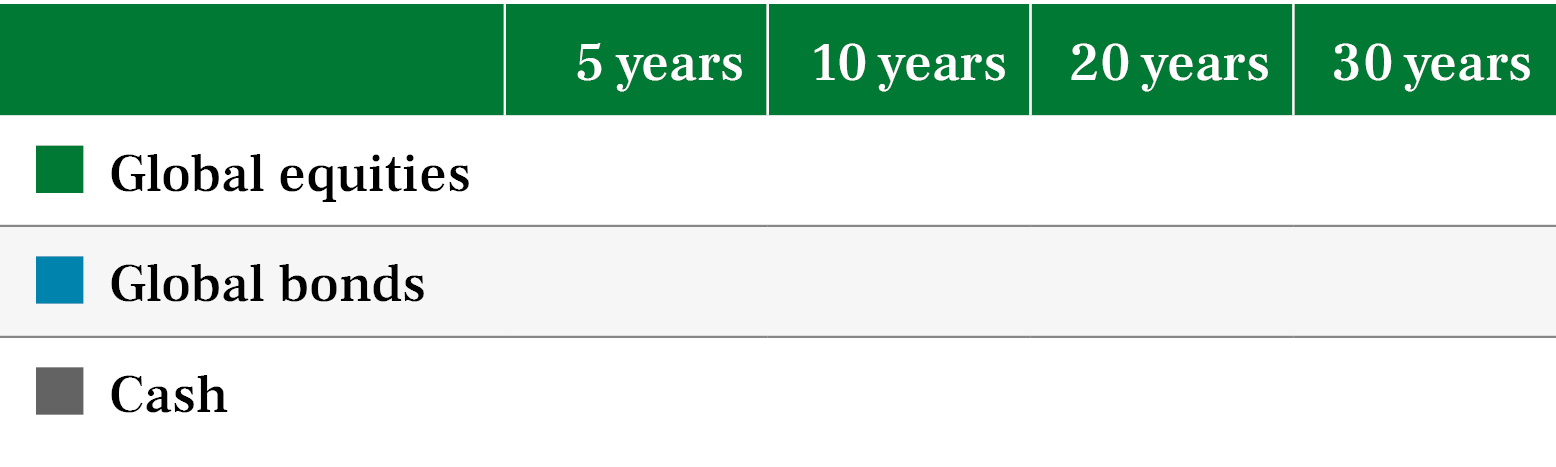
The chart below shows that over the long term there is an upward trend of market returns, despite the short-term volatility caused by major events. In fact, if you invested into global equities 30 years ago, your investment could have grown to be worth more than 13 times its original value.
The performance figures shown refer to past performance. Past performance is not a reliable indicator of future performance. Source: Quilter and Morningstar as at 30 June 2026. Total return, percentage growth over period 1 July 1996 to 30 June 2026. Global equities are represented by the MSCI All Country World Index, global bonds by the Bloomberg Global Aggregate Index, and cash by the Bank of England Base Rate.
Do not let short-term blips distract you from your long-term plan. People who stay invested are more likely to see their investments recover. Investing over the long term (five years or more) is more likely to be successful.
Cumulative returns
5 years
10 years
20 years
30 years
78%
3%
7%
Global equities
Global bonds
Cash
Click here to see the returns over different time periods
The performance figures shown refer to past performance. Past performance is not a reliable indicator of future performance. Source: Quilter and Morningstar as at 30 June 2026. Total return, percentage growth over period 1 June 1996 to 30 June 2026. Based on an initial investment of £10,000. Global equities are represented by the MSCI All Country World Index, global bonds by the Bloomberg Global Aggregate Index, and cash by the Bank of England Base Rate.
79%
252%
680%
1,229%
2%
12%
90%
308%
19%
21%
42%
136%
During periods of volatility it can be tempting to exit the market, but missing just a few of the best days can have a big impact on your overall return.
The chart below shows that if you stayed invested in global equities over the past 30 years, you could have received a potential return more than four times greater than someone who tried to time the market and missed the best 25 days.
Time in the market is usually more successful than trying to time the market. Keeping your money invested means you can benefit from any upsides or bounces. Missing just a few good days can significantly reduce how much your investment grows.
The performance figures shown refer to past performance. Past performance is not a reliable indicator of future performance. Source: Quilter and Morningstar as at 30 June 2026. Total return in pounds sterling over period 1 July 1996 to 30 June 2026. Global equities are represented by the MSCI All Country World Index.
We are dedicated to making sure your investment journey with us is as smooth as possible. Please visit our website at quilter.com for all the latest news, views, and portfolio information.
Before making any decisions, we recommend you speak to your financial adviser and get some expert advice. Your financial adviser is responsible for understanding your specific investment objectives and appetite for risk. They will work closely with you to determine what is right for you.
If you are a financial adviser and want to find out more about our investment solutions, please speak to one of our investment directors on 0207 167 3700, email us at enquiries@quilter.com, or visit our website at quilter.com.
Need additional help reading documents?
More and more of our investors are using screen reading software as a quick and easy way to read their documentation if they are blind, partially sighted, or dyslexic. Alternatively, we can write to you in several alternative formats, such as large print, braille, audio, and OpenDyslexic font. Find out more about screen readers, accessing your documents online, and our alternative format options at quilter.com/document-help.
quilter.com This communication is issued by Quilter, a trading name of Quilter Investment Platform Limited. Quilter Investment Platform Limited is registered in England and Wales under number 01680071. Registered office at Senator House, 85 Queen Victoria Street, London, EC4V 4AB. Quilter Investment Platform Limited is authorised and regulated by the Financial Conduct Authority under reference number 165359. Quilter uses all reasonable skill and care in compiling the information in this communication and in ensuring its accuracy, but no assurances or warranties are given. You should not rely on the information in this communication when making investment decisions. Nothing in this communication constitutes advice or a personal recommendation. This communication is for information purposes only and is not an offer or solicitation to buy or sell any Quilter product. Data from third parties is included in this communication and those third parties do not accept any liability for errors and omissions. You should read the important information provided by the third parties, which can be found at quilter.com/third-party-data. Approver: Quilter July 2026 QI 26736/205/17775